“Live a little” Campaign Concept

Updated: Aug 16
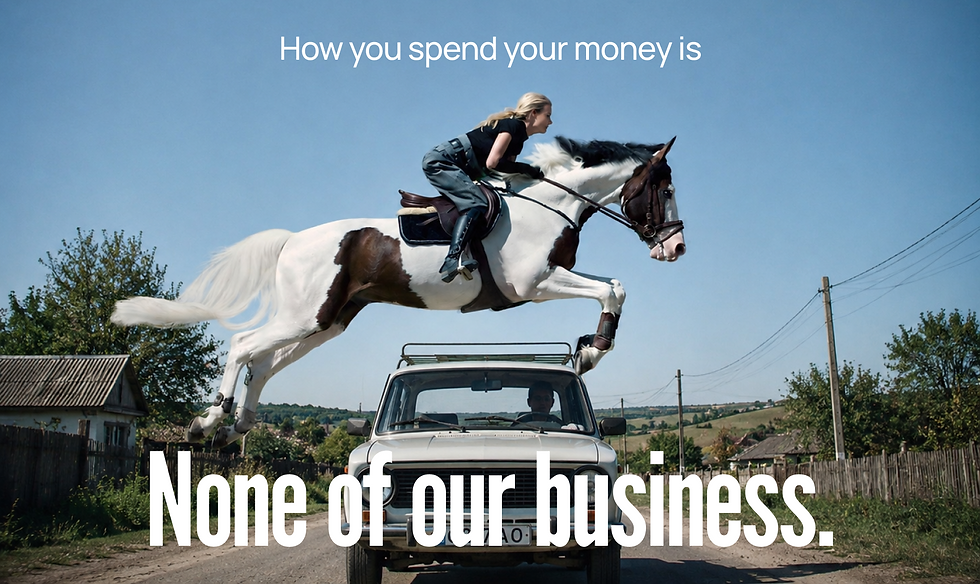
Turning micro cash loans into a permission slip to live freely, Live a Little shows how financial liberation can be found in even the smallest of purchases.

Client: iute Markets: Bulgaria
Channels: Meta & OOH
The Big Idea
Iute’s legacy audience is in their mid-thirties and forties. We're missing out on customers aged 21–29. But putting younger people in traditional loan ads isn't going to make the brand feel younger. We have an opportunity to position micro cash loans around things this audience already spends money on (coffee, clothes, dinner, technology and going out), and push back against a very familiar narrative while we were at it.
Stop ordering delivery
Stop buying coffee.
Stop going out.
Save everything or you'll never retire.
Snore. We've all heard it.
Our response:
Enjoy your twenties. We got you.
Plan for the future. Live in the moment.
A little party never killed nobody.
Your five-year plan has room for Friday night.
The world is ending, buy the good stuff.
Lattes don’t ruin retirement.
Live a little.
The product becomes the supporting act, quality of life is the hero.
Why it makes sense:
Customer: We connect to existing customer behaviours instead of inventing new ones.
Brand: We speak their language instead of leading with a one-size-fits-all approach to loans.
Business: We can acquire new customers while they're young and keep them as customers for a long period of time.
The test
A/B: Customer-outcome creative vs. product-led control (Meta)
Primary KPI: New customer loan applications (submitted)
Secondary: CAC, CTR

The Creative
Q: How do you craft visuals that feel young without trying? A: The aesthetics of MESS. Lives that feel lived-in.
Financial responsibility is usually shown as polished, organised and painfully sensible. I'd prefer to show something real: people who stay out late, spend money on having a life, and still have their sh*t together. Direct flash, imperfect framing, half-eaten food, receipts on tables, lives being lived in.

AI & Scalability
We'll create in English but scale to Bulgarian (+ languages when we're ready). Flexible components can handle longer copy while local teams follow one rule: Translate the feeling, not the headline.
I've built repeatable AI image workflow so we can create more lifestyle scenarios without losing the campaign's visual language. The goal isn't to make 40 assets myself. The goal is to ensure that the 41st asset will be strong even if I'm not in the room.

Taking it outside
For OOH, everything should get stripped back. One moment, one line, one action.
"Use code SLICE for lowest available interest" can be our tracker. The unique code gives us a simple way to connect billboard exposure with applications and new customers. Short, concise, and an homage to cutting both interest and pizza.

Will it work?
We'll monitor: Completed application count from 21–29s vs. product-led control
Change in customer acquisition cost for 21–29s vs. product-led control
Change in CTR on the strongest creative vs. product-led control
Change in our customer pool percentage of of 21–29 year olds during and after the campaign (as compared to what percentage we have currently)
My hypothesis:
Moments will beat products. Food and fun will convert better than technology.
Context will beat reach. Walkable-area billboards will generated more attributed applications than commuter placements. People can't remember a code while driving.
Local adaptations will be more successful so long as we translate the feeling, not the headline.
I want our takeaway to be: You can in fact buy a latte every day and still be financially responsible. Iute's got you covered in your twenties.
My criticism
Young people are notably less financially mature than older customers. Statistically they'll have less financial wiggle room to work with. However, that makes them perfect for a micro loan campaign.
With an audience this specific, we need to be realistic about the size of the prize. A campaign can't speak directly to every customer persona without eventually saying very little to anyone. But go too narrow and we risk limiting the impact before we've even started. The job is finding the sweet spot: specific enough to feel made for 21–29s, broad enough to make the investment worthwhile.


Comments